
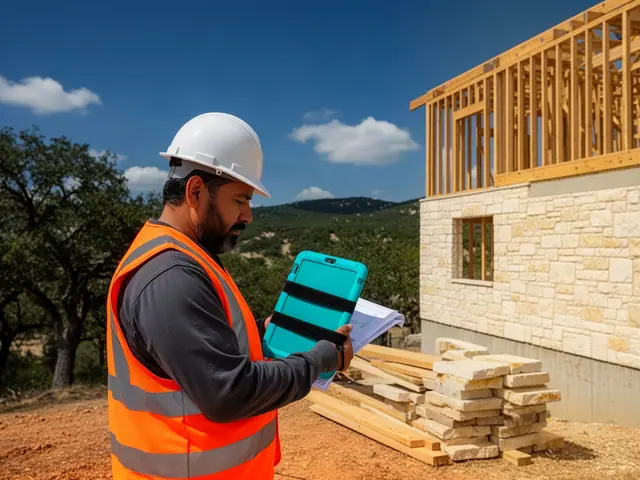
Contractor cash flow is the timing of money out for labor, materials and equipment against money in from draws and final payments. Canyonwick Finance, a small-business funding broker in New Braunfels, TX, explains how Comal County contractors can forecast the gaps and which funding fits each. Lending partners decide on any request.
Why this matters in Comal County, TX
Construction is the county's largest sector by number of employers: 689 employer establishments in 2023, and 61.2 percent of them had fewer than five employees (U.S. Census Bureau, County Business Patterns 2023). Another 2,462 construction businesses ran with no employees at all in 2024 (U.S. Census Bureau, Nonemployer Statistics 2024; a separate survey, not to be added to the employer count). Small outfits have the thinnest cushions, so a single late draw can push payroll into the red.
Residential building has kept crews busy. The county authorized 3,249 new housing units in 2023 and 3,430 in 2024, and 1,726 in 2025 (U.S. Census Bureau, Building Permits Survey). More work does not fix timing gaps; it usually makes them larger, because each new job needs crews and materials paid up front.
What cash flow in construction actually means
Profit and cash flow are different. A job can be profitable on paper and still drain cash for weeks, because the contractor pays wages every week, buys materials on supplier terms and waits for payment after billing, inspection and approval. Some contracts also hold back a share of each payment until the job is finished. Cash flow is the running balance of those ins and outs, week by week.
Common contractor cash flow issues
- Front-loaded costs. Mobilizing a job, buying materials and the first weeks of labor all come before the first draw.
- Slow approvals. Each extra signature between your pay application and the check adds days to the gap.
- Held-back payments. Money withheld until completion sits on your books as earned but uncollected.
- Overlapping jobs. Starting the next job before the last one pays out stacks two gaps.
- Equipment bought from operating cash. A machine paid in cash can leave nothing for payroll.
A simple weekly forecast layout
A forecast does not need software. A spreadsheet with one column per week for the next twelve weeks and these rows is enough:
| Row | What goes in it |
|---|---|
| Opening cash | Cash in the business account on Monday morning |
| Expected draws and payments | Each job's expected payment, on the week you realistically expect it |
| Payroll | Wages and payroll taxes for every crew |
| Materials and subcontractors | Supplier invoices by due date |
| Equipment and vehicle payments | Loan, lease and fuel costs |
| Overhead | Rent, insurance, phones, software |
| Closing cash | Opening cash plus money in, minus money out |
Any week where closing cash goes negative is a gap. Note how big it is, how long it lasts and which incoming payment closes it. That last point is what a lending partner will want to know.
Matching funding to the gap
- Repeating gaps between draws: a business line of credit, drawn for each job and repaid when the draw arrives.
- A machine you need for years: equipment financing, so the purchase does not come out of payroll cash. Test a payment first with the mini excavator calculator.
- A single large mobilization: short working capital with a clear payoff from the job's first draw.
If the forecast shows a gap every week with no payment that closes it, the issue is pricing or billing terms rather than funding. Borrowing to cover that kind of gap makes it bigger. Contractor financing covers what partners look for in a contractor's file.
Habits that shrink the gap
- Bill promptly at every milestone the contract allows.
- Negotiate a mobilization payment on larger jobs.
- Ask suppliers for terms that line up with your draw schedule.
- Keep business and personal accounts separate so statements show the business clearly.
- Update the forecast weekly, not when the account is already short.
For local business figures around the office, see the area business profile. The rest of our notes for owners are on the Canyonwick blog.
By Canyonwick Finance · Updated